Naming Emotions
Name It to Tame It: Why Labelling Your Emotions Actually Works

The human mind is not the problem. It is just busy.
It is constantly scanning, predicting, protecting. Sometimes that protection shows up as anxiety. Sometimes as irritability. Sometimes as tears you did not see coming.
One of the most powerful emotional regulation tools we have is surprisingly simple: name what you are feeling.
It sounds almost too easy. But it works.
What does “Name It to Tame It” actually mean?
The phrase was popularised by psychiatrist Daniel J. Siegel, and it captures a core psychological principle: when we accurately label an emotion, we reduce its intensity.
When you say,
“I am anxious,”
or
“I feel disappointed,”
or even
“I think I am actually overwhelmed, not angry,”
you are doing more than narrating your inner world.
You are activating your prefrontal cortex, the part of your brain responsible for reasoning, perspective, and regulation. At the same time, you reduce activity in the amygdala, the brain’s threat detection centre.
In other words, you move from being flooded by emotion to relating to it.
That is regulation.
Why naming emotions matters
When we do not name emotions, they tend to leak out sideways.
Overwhelm turns into snapping at your partner.
Shame turns into withdrawal.
Fear turns into control.
Sadness turns into “I’m just tired.”
If it is unnamed, it feels global and consuming.
If it is named, it becomes specific and workable.
“I am a mess” becomes
“I am grieving.”
“I cannot cope” becomes
“I am overstimulated and need a break.”
See the difference? One feels hopeless. The other feels actionable.
Naming creates space
Emotions are not meant to be suppressed. They are signals.
But when we judge ourselves for having them, we add a second layer of suffering.
“I shouldn’t feel this way.”
“What is wrong with me?”
“I’m too sensitive.”
Naming an emotion interrupts that spiral. It shifts you from self criticism to self awareness.
Instead of fighting the feeling, you acknowledge it.
Instead of being swallowed by it, you observe it.
That shift creates space.
And space is where choice lives.
It improves your relationships too
When you can clearly identify your emotional experience, you communicate differently.
“I’m angry” often becomes
“I felt hurt when that happened.”
“I don’t care” becomes
“I actually felt left out.”
Clear emotional language builds connection. It reduces defensiveness. It invites empathy.
You cannot expect others to understand your inner world if you have not first slowed down enough to understand it yourself.
How to practice “Name It to Tame It”
This is not about over analysing every feeling. It is about building emotional literacy.
Try this:
• Pause when you notice a shift in your mood
• Ask yourself, “What am I feeling right now?”
• Get specific. Not just “bad” or “stressed”
• Add a qualifier. “I feel anxious about the meeting tomorrow.”
• Notice what happens in your body once you name it
You might feel a subtle settling. A softening. A bit more clarity.
That is your nervous system moving toward regulation.
The truth
You cannot regulate what you refuse to recognise.
Naming an emotion does not make you dramatic. It makes you aware. It makes you skilful. It makes you responsive rather than reactive.
Your emotions are not weaknesses. They are information.
And when you name them, you give yourself the power to work with them, not against them.
If this is something you struggle with, therapy can help you build that emotional language and confidence. Emotional regulation is not about being calm all the time. It is about knowing what is happening inside you and responding with intention.
And that starts with naming it.
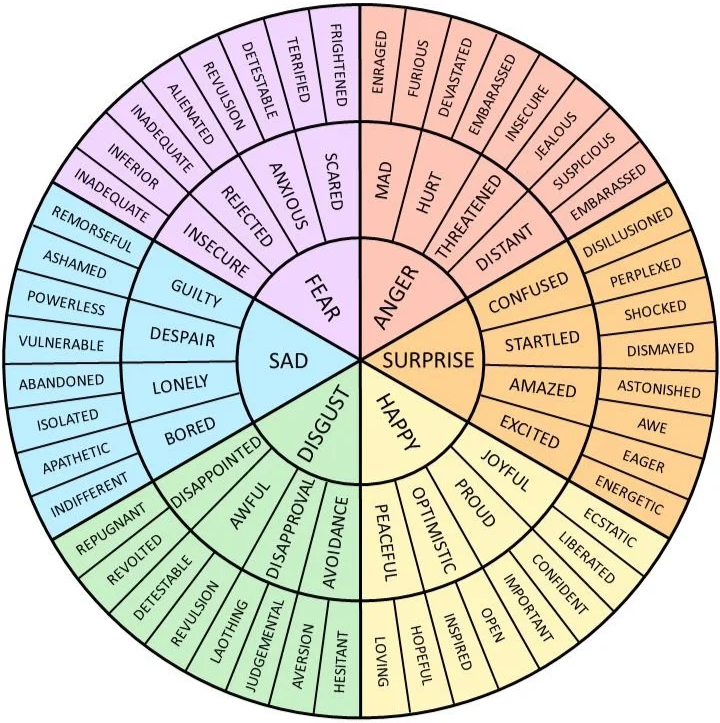
Need help naming your feelings?
This is the Feelings Wheel.
A tool that helps us name our emotions when we aren’t sure or struggling to find the words.
The Feelings Wheel: Building Emotional Literacy One Word at a Time
If “I don’t know, I just feel off” is a regular sentence in your vocabulary, the feelings wheel is about to become your new best friend.
The feelings wheel is a simple visual tool that helps you move from vague emotional labels like “bad” or “stressed” to more specific words like “disappointed,” “overwhelmed,” “rejected,” or “under appreciated.” It usually starts with core emotions in the centre, think sad, mad, scared, happy, and expands outward into more nuanced feelings.
Why does this matter?
Because specificity changes everything.
When you say “I’m angry,” that can mean a hundred different things. When you say “I feel dismissed,” now we are working with something clear. Clear emotions are easier to regulate. Easier to communicate. Easier to respond to.
Using a feelings wheel strengthens emotional literacy, which is the ability to recognise, name, and understand your internal experience. And as we know, you cannot regulate what you cannot identify.
It is not about overthinking. It is about getting accurate.
Next time you feel emotionally activated, pause and scan the wheel. Start in the centre and work your way out. See what word actually fits. Your nervous system tends to settle when your experience feels understood.
Sometimes growth starts with expanding your vocabulary.