The Window of Tolerance
Why You’re Not “Overreacting”, Your Nervous System Is Just Busy
Ever snapped at someone and thought,
“Why did I react like that?”
Or completely shut down in a moment that didn’t seem that big?
Chances are, you were outside your window of tolerance.
Let’s talk about it.
The concept was developed by Dan Siegel, and it describes the zone where your nervous system can handle stress without becoming overwhelmed or shutting down.
Inside your window, you can:
• Think clearly
• Feel your emotions without being flooded
• Stay connected to yourself and others
• Respond instead of react
Outside your window, things get messier.
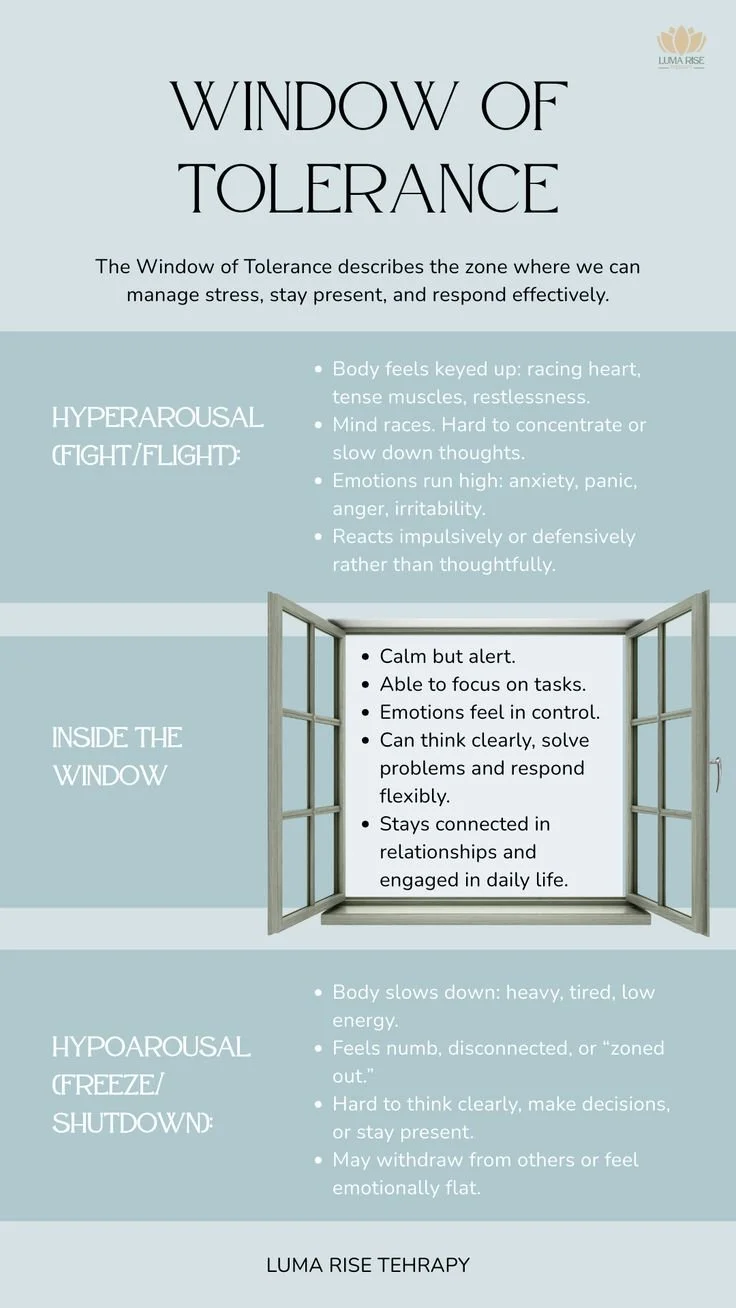
Image source: Luma Rise Therapy (www.lumarisetherapy.com/home)
When You Move Above the Window
This is hyperarousal.
Your system shifts into fight or flight.
You might feel:
• Anxious
• Irritable
• Restless
• Panicky
• Overstimulated
• Snappy
Your heart rate increases. Your thoughts speed up. Everything feels urgent.
This is not you being dramatic.
This is your nervous system trying to protect you.
When You Drop Below the Window
This is hypoarousal.
Your system shifts into shutdown.
You might feel:
• Numb
• Flat
• Disconnected
• Exhausted
• Foggy
• Withdrawn
You are not lazy.
You are not unmotivated.
Your body has decided that shutting down feels safer than staying activated.
Why Your Window Might Be Smaller Than You’d Like
Stress, trauma, burnout, lack of sleep, pregnancy, parenting, relationship strain, hormonal shifts, big life transitions. They all impact your nervous system.
If you are in a season of change, your window might feel narrower. It does not mean you are failing. It means your system is carrying more.
When your window is smaller, smaller stressors can push you outside of it.
That is not weakness.
That is physiology.
Regulation Is About Returning, Not Staying Calm
The goal is not to never leave your window. That is unrealistic.
The goal is to notice when you are outside of it and gently guide yourself back.
Above the window?
Slow breathing. Cold water on your face. Grounding. Movement that discharges energy.
Below the window?
Gentle activation. Light, sound, music. Stretching. Connection. Small achievable tasks.
Different states require different strategies.
The Part No One Talks About
Shame shrinks your window.
When you criticise yourself for reacting, you add another layer of activation.
“I shouldn’t feel like this.”
“What’s wrong with me?”
Nothing is wrong with you.
Your nervous system learned patterns based on past experiences. It is doing what it thinks is safest.
Healing is not about forcing calm. It is about expanding your capacity.
Over time, with safety, support, and intentional regulation practices, your window can widen. You tolerate more. You recover faster. You feel more steady.
Not perfect. Steadier.
A Gentle Reflection
Ask yourself:
• What does being inside my window feel like?
• What are my early signs I’m moving above it?
• What are my early signs I’m dropping below it?
• What helps me return?
Awareness comes first. Regulation follows.
You are not too sensitive.
You are not too much.
You have a nervous system.
And when you understand it, you stop fighting yourself and start working with it.
That is where real resilience lives.